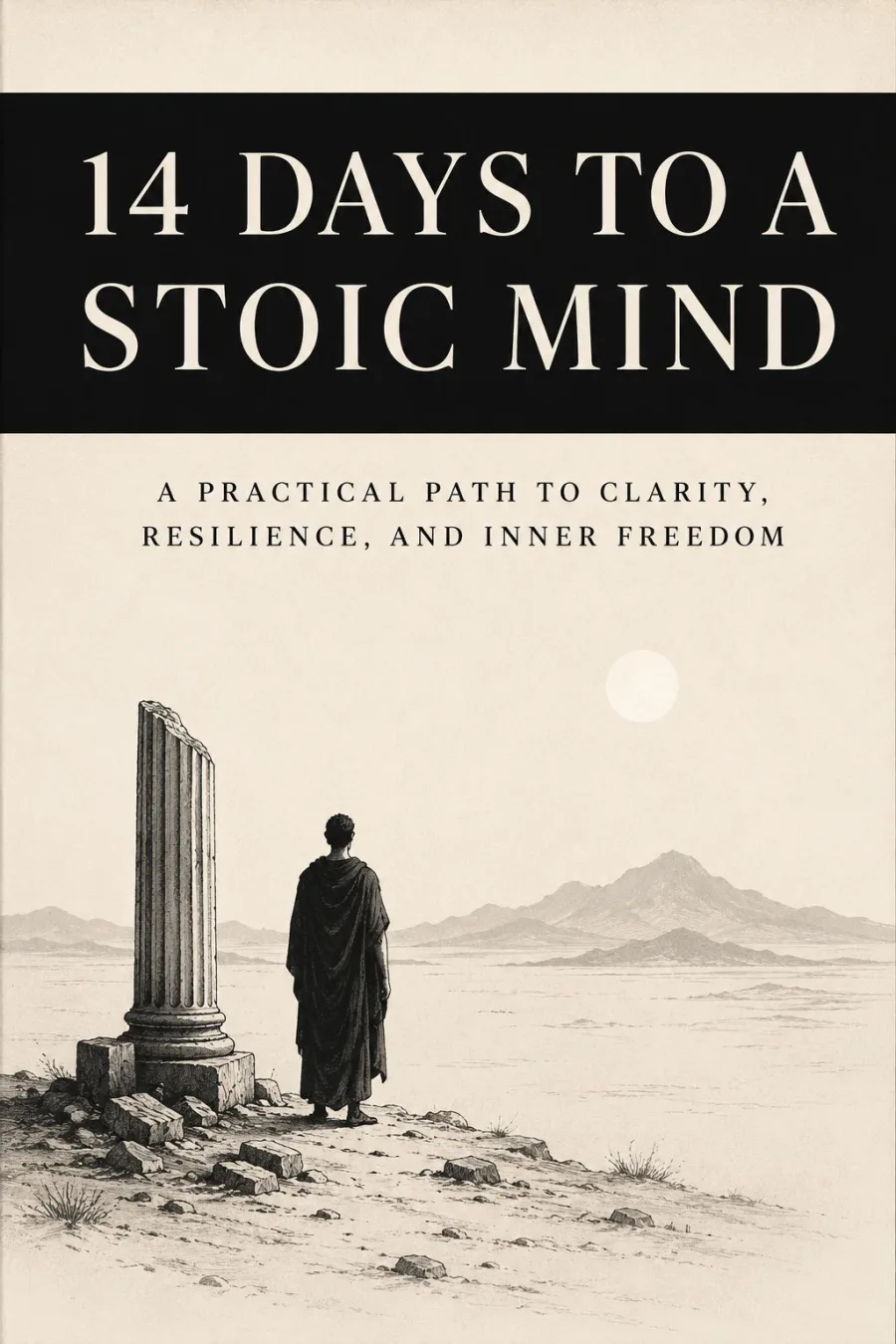
14 Days to a Stoic Mind book cover
A Daily Reader · 42 Pages

Two weeks with the strongest minds in history.

One master a day, for fourteen days. Three short pages each: a quote in its classic translation, what it actually means, and one suggestion for living with it today. Marcus Aurelius, Seneca, Sun Tzu, Epictetus, Musashi, and nine more.

14
Days
14
Masters
42
Pages
10
Min / Day

Fourteen Voices Across Twenty-Five Centuries

The Stoics anchor the book. The lineup widens out to the masters Stoics have always read alongside themselves: warriors, mystics, exiles, an emperor, a slave, and one modern admiral who carried Epictetus into a Hanoi prison cell.

Day 1
Marcus Aurelius
121–180 CE · Roman Stoic Emperor
The emperor who kept a private journal of Stoic exercises during a plague and a frontier war, and never meant for anyone to read it.
Day 2
Seneca
c. 4 BCE – 65 CE · Roman Statesman
Turned Stoic ethics into the most readable Latin prose ever written about how to live and how to die.
Day 3
Confucius
551–479 BCE · Chinese Sage
The wandering teacher whose recorded conversations became the operating system of East Asian moral life for twenty-five centuries.
Day 4
Epictetus
c. 50–135 CE · Greek Stoic Teacher
The freed slave whose handbook on the dichotomy of control became Stoicism's most portable weapon.
Day 5
Sun Tzu
c. 5th c. BCE · Chinese Strategist
The general whose treatise on strategy has been read by every serious commander for two and a half millennia.
Day 6
Miyamoto Musashi
1584–1645 · Japanese Kensei
The undefeated swordsman who spent the last year of his life alone in a cave writing down the way of strategy.
Day 7
Cato the Younger
95–46 BCE · Roman Senator
The senator who walked the Stoic walk into civil war and chose death over submission to Caesar.
Day 8
Friedrich Nietzsche
1844–1900 · German Philosopher
The philologist-turned-philosopher who attacked herd morality, demanded self-overcoming, and was misread by everyone for a century.
Day 9
Arthur Schopenhauer
1788–1860 · German Philosopher
Held that reality is blind striving will, that life is suffering by design, and that the honest response is compassion and self-discipline.
Day 10
Fyodor Dostoevsky
1821–1881 · Russian Novelist
The novelist who treated suffering, faith, freedom, and doubt as the central problems a human being can have.
Day 11
James Stockdale
1923–2005 · US Navy Vice Admiral
Carried Epictetus into a North Vietnamese prison and credited the Enchiridion with keeping him whole for seven and a half years.
Day 12
Socrates
c. 470–399 BCE · Athenian Philosopher
The Athenian who wrote nothing, asked the questions that broke the city's complacency, and drank hemlock rather than stop.
Day 13
Heraclitus
c. 535–475 BCE · Pre-Socratic
The pre-Socratic who wrote one book of dense oracular fragments about fire, flux, and the hidden logos that orders the world.
Day 14
Laozi
c. 6th–4th c. BCE · Daoist Sage
The half-legendary sage whose 81 short chapters on the Way teach that the soft overcomes the hard and the wise act by not forcing.

The First Page, in Full

Every page has the same shape: an archaic-translation quote, a one-sentence modern paraphrase, a short essay, and a Try-this suggestion. Three of these per master. Forty-two in all.

Day 1 · Marcus Aurelius
— I —

Look within. Within is the fountain of good, and it will ever bubble up, if thou wilt ever dig.

Marcus Aurelius, Meditations 7.59 (trans. George Long, 1862)

In plain English: Whatever calm, courage, or clarity you need today is already inside you. The work is not to wait for it. The work is to dig past the noise.

Marcus is making a concrete claim, easy to miss in the older language. The good he names is not a feeling and not a mood. It is the working set of inner resources a serious adult uses to get through a day: the ability to think clearly under pressure, to choose your response, to refuse what would diminish you, to act well when no one is watching. These are not handed out by status, wealth, or luck. They come standard with being human. Most people never use them, because they have been trained to look outside themselves for the same goods.

Marcus is writing this between dispatches on the Danube frontier. He is the emperor of the known world. He has armies, scribes, gold, and the obedience of millions. If anything could be arranged externally, he could arrange it. None of it produced the steadiness he needed. He writes the line to himself, in private, because the answer was not out there for him either, and is not out there for the rest of us.

The dig is small and daily. A few quiet minutes before reaching for the phone. One honest sentence in a notebook before the day starts pulling at you. One pause before the reactive sentence leaves your mouth. Repeated over weeks, it produces a person who can meet the day from inside rather than chase it from outside. The water comes up if you let it.

Try this: Some possibilities: take five quiet minutes today before opening your phone, and notice what surfaces in the space. Or pick one inner resource (patience, focus, courage) you usually try to import from outside, and watch this week for the moments it shows up in you on its own.
One price. Yours forever.

No subscription, no expiration, no upsell. Pay once, read on any device.

$5
Book Only
  • The complete 14-day reader as a downloadable PDF
  • 42 pages, carefully typeset in serif
  • Every quote verified to its primary source
  • Reads cleanly on Kindle, iPad, iPhone, desktop
Secure checkout via Razorpay · PDF emailed after payment